

Don’t Let the Humidity Squeal: Diagnosing Serpentine Belt Wear During Miami Valley Summers
Last July, a Kia Sportage came into our service bay on a flatbed after the owner had been stranded on I-70 near the Huber Heights exit. The serpentine belt had snapped completely, taking the power steering, alternator, and air conditioning with it in an instant. The owner had noticed a faint squealing sound on humid mornings for about six weeks before the failure but assumed it would go away on its own. The tow, the belt replacement, and the tensioner that had also worn past spec came to $580. The belt inspection and replacement they had passed on at their last service? $95.
That story is not unusual in the Miami Valley. Dayton’s summer humidity, which routinely pushes past 80 percent during July and August, creates exactly the conditions that accelerate serpentine belt wear in ways that drivers in drier climates simply don’t encounter. The moisture that hangs over the Great Miami River corridor, the heat radiating off Old Troy Pike and I-75 during afternoon rush hour, and the constant thermal cycling an engine goes through during a Dayton summer all work against the rubber compounds that keep a serpentine belt functioning properly.
A serpentine belt failure is one of the most avoidable roadside breakdowns in existence. It announces itself with symptoms that are easy to recognize once you know what to listen for, and the cost of replacing it on schedule is a fraction of what a failure costs in towing, labor, and the secondary damage it can cause. This guide walks you through exactly what the belt does, what Miami Valley summers do to it, and how to stay ahead of the wear.
What Your Kia’s Serpentine Belt Actually Does
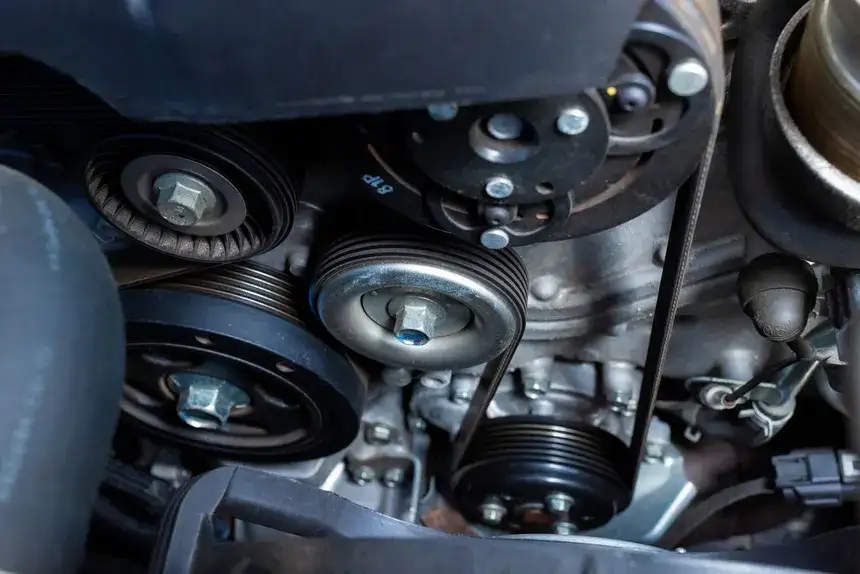
The serpentine belt is a single continuous loop of reinforced rubber that winds through a series of pulleys driven by the engine’s crankshaft. It is the power transfer system for nearly every accessory your Kia depends on to function.
What the Belt Drives
On most Kia models, including the Sportage, Sorento, Telluride, and Soul, the serpentine belt simultaneously drives the alternator that charges the battery and powers the electrical system, the power steering pump on non-electric steering systems, the air conditioning compressor, and the water pump on many configurations. All of these components stop functioning the moment the belt fails. The engine continues running, but within minutes the battery begins draining, the coolant stops circulating, and the cabin temperature rises without air conditioning. On a Dayton summer afternoon, that sequence moves quickly.
The Tensioner and Idler Pulleys
The belt does not work alone. A spring-loaded tensioner pulley maintains the correct tension on the belt as it stretches and wears over time. Idler pulleys guide the belt along its path through the accessory drive system. When the tensioner loses its spring tension, the belt slips under load, which produces the squealing sound that is one of the most recognizable early warning signs of belt system wear. Worn idler pulley bearings produce a chirping or grinding noise that is distinct from belt squeal but equally worth addressing. On most Kia models, the tensioner and idler pulleys are replaced alongside the belt because their service lives are similar and the labor to access them is already completed during belt replacement.
What Miami Valley Summers Do to Rubber
The serpentine belt on your Kia is made from EPDM rubber, a compound chosen for its resistance to heat, ozone, and mechanical stress. It is a durable material. But durable does not mean immune to the specific combination of conditions that Dayton summers deliver.
Heat and Thermal Cycling
Surface temperatures in the engine bay of a Kia running on a 90-degree July afternoon in Huber Heights can exceed 200 degrees Fahrenheit in the accessory drive area. The belt expands under that heat and contracts when the engine cools overnight. Every thermal cycle stresses the rubber compound slightly, and over thousands of cycles across multiple Dayton summers, that stress manifests as hardening, glazing, and eventually cracking in the belt’s ribs.
A glazed belt surface loses its grip on the pulleys it drives. This is what produces the intermittent squeal on humid mornings, when condensation on the belt and pulley surfaces reduces traction momentarily before the belt warms up and the moisture burns off. That morning squeal is not the belt waking up. It is the belt telling you its surface has hardened past its service life.
Humidity and Moisture Intrusion
Dayton’s summer humidity adds a layer of wear that drivers in drier climates don’t deal with to the same degree. The moisture that settles on engine components overnight, particularly during the humid stretches that come off the Great Miami River basin and hang over communities like Huber Heights, Trotwood, and Riverside through July and August, causes the belt surface to swell and contract on a daily cycle that is separate from the thermal cycling the engine creates.
High humidity also accelerates oxidation on the pulley surfaces and bearing seals of the tensioner and idler pulleys, which contributes to the uneven wear patterns and bearing noise that often accompany a belt that has been running in Miami Valley conditions for several seasons without inspection.
The Stop-and-Go Load Factor
The driving environment around Old Troy Pike, the US-40 corridor through Huber Heights, and the afternoon traffic on I-70 approaching the Dayton area adds a load factor that highway cruising does not. Every time the engine accelerates from a stop, the serpentine belt absorbs a spike in load as the alternator and air conditioning compressor ramp up their demand simultaneously. In stop-and-go summer traffic with the air conditioning running continuously, that load spike happens dozens of times per commute. Over a Dayton summer, the cumulative belt stress from that driving pattern is meaningfully higher than what the same vehicle would experience on a steady highway commute.
Warning Signs Your Kia’s Serpentine Belt Needs Attention
Recognizing these symptoms early is the difference between a scheduled service appointment and a flatbed tow on I-70. Watch and listen for the following:
- Squealing on startup or on humid mornings that fades after a few minutes of running, which is a classic sign of a glazed belt surface losing traction on the pulleys momentarily
- Chirping or grinding from the engine bay at idle or under light acceleration, which points to worn tensioner or idler pulley bearings rather than the belt surface itself
- Visible cracking or fraying on the belt’s outer surface or along the rib edges, which can be seen with a flashlight during a brief engine-off inspection
- Glazed or shiny appearance on the ribbed underside of the belt, indicating the rubber has hardened and lost its grip surface
- Air conditioning performance dropping during acceleration or under heavy electrical load, which can indicate a slipping belt that is not maintaining consistent drive on the compressor
- Battery warning light appearing without an obvious electrical cause, since a slipping belt reduces alternator output and allows the battery voltage to drop under load
- Power steering feeling heavy during low-speed maneuvers, another indicator of belt slip on vehicles with hydraulic power steering
Any one of these symptoms during a Dayton summer is worth investigating before the next drive rather than after.
How Often Miami Valley Kia Owners Should Inspect Their Belt
The generic replacement interval for serpentine belts on most vehicles is 60,000 to 100,000 miles. That range was developed around average driving conditions and average climate exposure. Dayton’s summer humidity and thermal cycling place Kia owners in the higher-wear end of that range, and an inspection schedule that reflects that reality makes more financial sense than waiting for the mileage marker.
For most Kia owners in the Huber Heights and broader Dayton area, a visual belt inspection at every oil change is a reasonable baseline. Any belt showing surface cracking, glazing, or rib wear at or before 60,000 miles in Miami Valley driving conditions should be replaced rather than monitored. The cost of the belt and tensioner together on most Kia models runs $95 to $180 depending on configuration. The cost of a failure on a summer afternoon is reliably several times that number before the tow truck arrives.
“The squealing people hear on humid mornings is the most ignored warning sign we deal with all summer,” says Rachel Nguyen, Service Advisor at the Old Troy Pike location. “Customers hear it, assume it will stop, and it does stop, right up until the belt fails on the highway. In Dayton’s summer humidity, a belt that squeals on startup is already telling you it needs attention. We’d rather replace it on our lift than have someone call us from the side of I-70.”
Your 30-Day Belt Inspection Action Plan
This week: Listen on your next few cold starts, particularly on a humid morning after the vehicle has sat overnight. A squeal or chirp that lasts for the first minute or two of running and then fades is the single most actionable early warning sign of belt wear in Miami Valley conditions. Also listen for any chirping or grinding at idle with the hood up, which points to pulley bearing wear that should be checked alongside the belt.
Within two weeks: With the engine off and fully cool, use a flashlight to inspect the belt where it is accessible in the engine bay. Look at the ribbed underside surface for any cracking between the ribs, fraying along the edges, or a shiny glazed appearance on the rib surfaces. None of these require tools to observe and all of them are clear indicators that a replacement should be scheduled before the next hot, humid stretch hits the Miami Valley.
By month’s end: If your Kia has more than 50,000 miles and has not had a belt inspection in the past year, schedule a service appointment for a full belt system check covering the belt condition, tensioner spring tension, and idler pulley bearing condition. Catching a belt that is approaching the end of its service life before peak summer humidity arrives is far preferable to catching it after.
These three steps take less than fifteen minutes of your time and can prevent a breakdown that ruins an afternoon and costs several times what a scheduled belt replacement would have.
Schedule Your Belt Inspection Today
The Sportage owner from the opening of this article came back after that flatbed tow and told us they had heard the squeal for weeks and hoped it would resolve on its own. They now schedule a belt inspection every spring before Miami Valley summer humidity arrives. Two seasons later, we caught a tensioner that was losing spring tension at their routine check, replaced it alongside the belt for $160, and they have not had a belt-related issue since.
A serpentine belt failure is one of the most preventable breakdowns on the road. In Dayton’s summer humidity, it is also one of the most common. The Miami Valley’s heat, moisture, and stop-and-go driving environment combine to wear belt systems faster than the generic maintenance schedule accounts for, and staying ahead of that wear is straightforward once you know what to look and listen for.
At Kia of Dayton, our certified technicians know exactly what Ohio summers do to Kia belt systems and inspect every component in the accessory drive system, not just the belt itself. We stock OEM-spec belts and tensioners for every Kia model and can complete a full belt service during any scheduled appointment.
Schedule your belt inspection today by contacting our service department or booking online. We’re located at 8560 Old Troy Pike, Huber Heights, OH 45424.
A healthy serpentine belt keeps your alternator charging, your air conditioning running, and your Kia moving through every humid Miami Valley summer without interruption. That is what staying ahead of the wear delivers.

0 comment(s) so far on Don’t Let the Humidity Squeal: Diagnosing Serpentine Belt Wear During Miami Valley Summers