

The 2026 Kia EV9 is Here: A Service Guide for Your All-Electric Family Hauler
Last month, an EV9 owner came in from Vandalia nine months after taking delivery, having never scheduled a service appointment because he assumed electric vehicles required no maintenance beyond charging. He had dismissed a subtle brake pedal feel change over the summer and hadn’t checked his tire pressure since January. When he came in, the rear tires were 11 PSI underinflated from months of temperature cycling, the brake fluid had absorbed measurable moisture through a Dayton summer and fall, and the cabin air filter was completely blocked after 14,000 miles of Greater Dayton air quality. The three-item catch-up service that addressed everything? $310. Twelve months of proper scheduled EV service that would have handled all of it incrementally? $180.
That gap between what EV ownership actually requires and what most new EV9 owners assume it requires is the conversation our service team at Kia of Dayton has regularly with families who made the switch from a Telluride or Sorento and carried over the assumption that fewer moving parts means fewer service needs. It’s a reasonable assumption. It’s also not quite accurate.
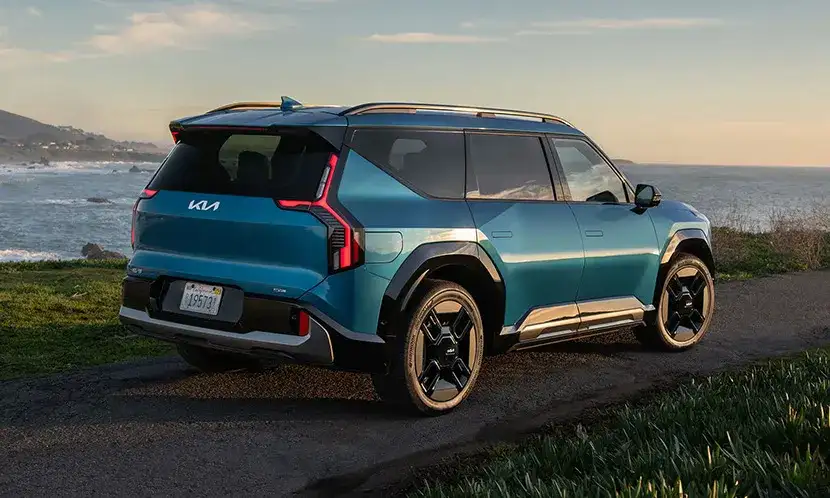
The 2026 Kia EV9 is one of the most capable and compelling three-row family vehicles on the market, electric or otherwise. Its 99.8 kWh battery pack, dual-motor AWD configuration, and 304 miles of EPA-estimated range make it genuinely suited for everything from the school run on Old Troy Pike to a family drive to Cincinnati or Columbus without a charging stop. But suited for the road and ready for the road are two different things, and knowing what this vehicle actually needs across its first year of Greater Dayton ownership sets the foundation for a long, reliable ownership experience.
This guide covers the complete EV9 service picture: what changes compared to a conventional Kia, what stays the same, what Ohio driving conditions specifically affect, and how to build a first-year maintenance plan that keeps your investment protected from day one.
What Changes About Service When You Go Electric
The EV9 eliminates several of the service items that define conventional vehicle ownership, and understanding what’s gone is as important as understanding what remains. There are no oil changes, no spark plugs, no timing belt, no transmission fluid, and no exhaust system service on the EV9. The absence of an internal combustion engine removes the entire category of engine-related consumable maintenance that accounts for a significant portion of conventional vehicle service costs over a five-year ownership period.
This is genuine and meaningful. Over 60,000 miles, a Telluride owner will spend somewhere between $1,200 and $1,800 on oil changes alone. The EV9 owner spends zero. That’s not a marketing claim. That’s arithmetic.
But the EV9 is not a maintenance-free vehicle. It’s a differently maintained vehicle, and the service items that remain are ones that Ohio driving conditions affect in specific ways worth understanding before the first service interval arrives.
What the EV9 Shares With Every Other Vehicle on Ohio Roads
Tires wear. Brakes need inspection. Cabin air filters clog. Brake fluid absorbs moisture. Wiper blades streak. Coolant circuits require attention. The EV9 has all of these systems, and in some cases the service requirements are more nuanced than on a conventional vehicle, not less.
The EV9’s battery thermal management system uses a dedicated liquid cooling circuit that is separate from the cabin climate system and operates continuously to keep the battery pack within its optimal temperature range. That cooling circuit uses its own coolant formulation on its own service schedule, distinct from anything in a conventional Kia powertrain. It’s not a complex service item, but it’s one that doesn’t exist on any ICE vehicle and requires awareness from the first year of ownership.
The Regenerative Braking Factor
The EV9 uses regenerative braking as its primary deceleration mechanism during normal driving, converting kinetic energy back into battery charge rather than dissipating it as heat through the friction brake system. In practice, this means the friction brakes on an EV9 are used significantly less aggressively than on a conventional vehicle.
Less friction brake use sounds like a maintenance advantage, and over the long term it is. Pad life on a well-driven EV9 can extend well beyond what a comparable ICE vehicle achieves. But the reduced use also means the rotors don’t self-clean through regular friction contact the way a conventionally braked vehicle’s rotors do. Surface corrosion that a Telluride clears through daily braking can accumulate more persistently on an EV9 that relies primarily on regen. 🔧
This makes the annual brake inspection more important on the EV9, not less, because the visual and tactile feedback that prompts a conventional vehicle owner to schedule brake service may be reduced or absent on a vehicle that rarely uses its friction brakes aggressively.
How Greater Dayton Conditions Affect Your EV9 Specifically
Ohio’s climate creates specific considerations for EV9 ownership that differ meaningfully from what a Kia EV9 owner in a moderate-climate market like the Pacific Northwest or Southeast experiences. Understanding these upfront prevents the kind of surprised discovery that our service team at the Old Troy Pike location sees regularly with first-year EV owners.
Battery Range in Ohio Winters
The EV9’s 304-mile EPA range estimate is measured at moderate temperatures. Cold weather meaningfully reduces usable range because the battery thermal management system draws power to maintain battery temperature, and the cabin heating system in an electric vehicle draws from the battery rather than from waste engine heat as it would in a conventional vehicle.
In genuine Huber Heights winter conditions, where overnight temperatures drop into single digits and morning commutes begin with a cold-soaked battery, real-world range on the EV9 can be 20 to 30 percent lower than the EPA figure. For a family planning a winter drive to Columbus on I-70 or up to Cleveland on I-71, understanding that the comfortable range buffer that exists in July is compressed in January is practical knowledge that affects charging planning, not a defect.
Preconditioning the EV9’s battery and cabin while still connected to the home charger is the most effective way to protect both range and battery health through an Ohio winter. The vehicle does this work on grid power rather than battery power, meaning it arrives at the start of every cold commute with a warm battery and warm cabin without having spent range to achieve either.
Heat, Charging, and the Old Troy Pike Corridor
Greater Dayton summers introduce a different set of battery considerations. Repeated DC fast charging sessions, the kind that might occur on a family road trip using chargers along I-70 through Columbus, generate heat in the battery pack that the thermal management system works to dissipate. In ambient temperatures above 90 degrees, which Huber Heights sees consistently through July and August, the thermal management system works harder and the battery benefits from not being fast-charged repeatedly to 100 percent.
Kia recommends keeping daily charging in the 20 to 80 percent state of charge range for regular use, reserving full charges for longer trips where the range is needed. This isn’t a rigid rule, but it’s a habit that supports long-term battery health in the temperature cycling environment that Southwest Ohio delivers across a full calendar year.
A Kia EV9 owner from Trotwood came in last August after noticing his estimated range had decreased noticeably over his first summer of ownership. He had been consistently fast-charging to 100 percent at the DC charger on Old Troy Pike before his daily commute. After a battery diagnostic and a conversation about charging habits, the range recovered as he adjusted his daily charge ceiling to 80 percent. No parts, no repair, no cost. The right information at the right time saved a warranty claim conversation that wasn’t necessary.
The Complete EV9 Service Schedule for Year One
Building a clear first-year service calendar removes the guesswork and prevents the kind of deferred maintenance that compounds quietly on a vehicle whose simple powertrain can create a false impression of no maintenance required.
At delivery and through month three:
Confirm your home charging setup is delivering the correct charge rate for the EV9’s onboard charger. A Level 2 home charger at 240 volts and 48 amps provides the full charge rate the EV9 supports. A standard 120-volt outlet charges at roughly 4 miles of range per hour, which is functional for short-commute owners but limiting for a 304-mile vehicle. Getting the home charging infrastructure right in the first 90 days of ownership shapes the entire ownership experience.
At 7,500 miles or six months:
Schedule your first EV9 service appointment at the Old Troy Pike location. This visit covers tire rotation, brake inspection with specific attention to rotor surface condition given the reduced friction brake use, cabin air filter assessment, tire pressure calibration after Ohio’s seasonal temperature swings, and a full vehicle inspection that documents baseline condition for warranty and resale purposes. This appointment typically runs under $100 and establishes your service record.
At 15,000 miles or twelve months:
The annual service visit adds a brake fluid moisture content test to the rotation and inspection items from the six-month visit. Ohio’s temperature cycling and humidity levels make annual brake fluid testing a practical priority on any vehicle, and the EV9’s reduced friction brake use doesn’t reduce brake fluid moisture absorption. If moisture content exceeds the service threshold, a brake fluid flush is the appropriate response.
Cost comparison across year one:
- Proactive EV9 year-one service plan, two appointments: $160 to $210
- Reactive approach, deferring all service until symptoms or warning indicators appear: $310 to $480 in catch-up service plus potential warranty documentation gaps
- Your savings from staying on schedule: $150 to $270 in year one alone, with compounding benefit in subsequent years 🔧
Warning Signs Your EV9 Is Telling You Something
Electric vehicles communicate differently than conventional ones, and knowing what to pay attention to prevents the easy assumption that a quiet, smooth-running EV9 is necessarily a problem-free one.
A reduction in displayed range that develops gradually over several months, beyond what seasonal temperature variation explains, can indicate battery capacity loss that warrants a diagnostic scan. Early identification preserves warranty claim options.
A change in brake pedal feel, specifically a pedal that travels further before engagement or feels less consistent than it did at delivery, warrants a brake system inspection given the reduced self-cleaning effect of regenerative braking on rotor surfaces.
Unusual sounds from the front or rear motor units during acceleration or deceleration, distinct from the normal EV whine, should be logged and reported at the next service visit or sooner if they develop quickly.
A persistent reduction in DC fast charge rate at chargers that previously delivered full power can indicate a battery thermal management issue or a charging system concern that a diagnostic visit will clarify.
Cabin air quality reduction, meaning the interior feels stuffy or the climate system seems less effective than it was at delivery, almost always traces back to a clogged cabin air filter, a straightforward and inexpensive service item.
“The biggest adjustment for EV9 owners coming from a Telluride or Sorento is recalibrating what ‘paying attention to the car’ looks like,” says James Whitaker, Lead EV Service Technician at the Old Troy Pike location. “You’re not listening for engine noise or watching for oil pressure drops. You’re monitoring range consistency, brake feel, and charge behavior. Those three things tell you almost everything you need to know about how the vehicle is doing between service visits.”
Your 30-Day EV9 Owner Setup Plan
This week: Confirm your home charging setup and establish your daily charge ceiling in the vehicle’s charging settings. Set the daily charge limit to 80 percent for routine use and note your typical overnight charge duration at that setting so you can schedule departure times accurately. If you haven’t yet set up a Level 2 home charger, contact a licensed electrician this week for a quote. The difference in daily charging convenience between Level 1 and Level 2 is significant enough that it affects the ownership experience meaningfully.
Within two weeks: Download the Kia Connect app if you haven’t already and confirm your EV9 is linked to your account. The app provides battery state, charge status, range estimate, and service reminder notifications that make EV ownership management significantly more convenient. Enable preconditioning scheduling so your battery and cabin are at optimal temperature before your morning departure, a habit that protects both daily range and long-term battery health through Huber Heights winters.
By month’s end: Schedule your first EV9 service appointment at the Old Troy Pike location and ask our service team to walk you through the EV-specific service calendar for your vehicle’s trim and configuration. Fifteen minutes of that conversation at your first appointment sets the maintenance framework for the next three years of ownership and ensures nothing falls through the gap between what you assumed electric service looked like and what it actually involves.
These three steps take less than two hours of total time and build the ownership foundation that separates a genuinely satisfying long-term EV9 experience from one that produces avoidable surprises.
The 2026 Kia EV9 is a genuinely exceptional vehicle for Greater Dayton families, and its lower long-term service costs compared to a conventional three-row SUV are real and meaningful. Getting those benefits requires understanding what service actually looks like on an electric vehicle, not assuming it looks like nothing.
Schedule Your EV9 Service Appointment Today
The Vandalia EV9 owner from the opening came back three months after his catch-up service with a proper service calendar in hand and his charging habits adjusted. His tires were rotated on schedule, his brake fluid was current, and his cabin air filter was clean. He told our service advisor it was the first time since delivery he felt like he actually understood what his vehicle needed. That’s the outcome a clear service picture delivers.
At Kia of Dayton, our EV-trained technicians service the EV9 with the model-specific knowledge, diagnostic equipment, and Kia-approved procedures that this vehicle’s technology requires. Whether you took delivery last month or have been driving your EV9 for a year without a service visit, we’ll meet you where you are and build a maintenance plan that protects your investment across every Ohio season ahead.
Schedule your EV9 service appointment today by contacting our service department or booking online. You’ll find us at 8560 Old Troy Pike, Huber Heights, OH 45424.
Proper EV service protects your battery investment, maintains the brake and safety system performance your family depends on, and ensures the 2026 Kia EV9 delivers everything it was engineered to deliver across every mile of Greater Dayton driving ahead. That is what informed electric vehicle ownership looks like.

0 comment(s) so far on The 2026 Kia EV9 is Here: A Service Guide for Your All-Electric Family Hauler